• Skip to primary navigation
  • Skip to main content

Newcity Art

Visual Art Culture of Chicago and Beyond

  • Newcity Art ·
    • About
    • Advertise
    • Breakout Artists
    • Featured Exhibitions
    • Privacy Policy
    • Newcity Network
  • Sections ·
    • Newcity
    • Design
    • Film
    • Lit
    • Music
    • Resto
    • Stage
    • Brazil
  • Newsletters
  • Subscribe
  • Members Hub
Newcity Art logo

H.C. Westermann’s “Anchor Clanker” Showcases the Sculptor’s Skill and Satire The Art Institute amasses the largest collection of works in over two decades by H.C. Westermann.

by Elisa Shoenberger | March 17, 2026

by Elisa Shoenberger
March 17, 2026March 16, 2026Filed under:
  • Featured
  • Loop
  • Sculpture
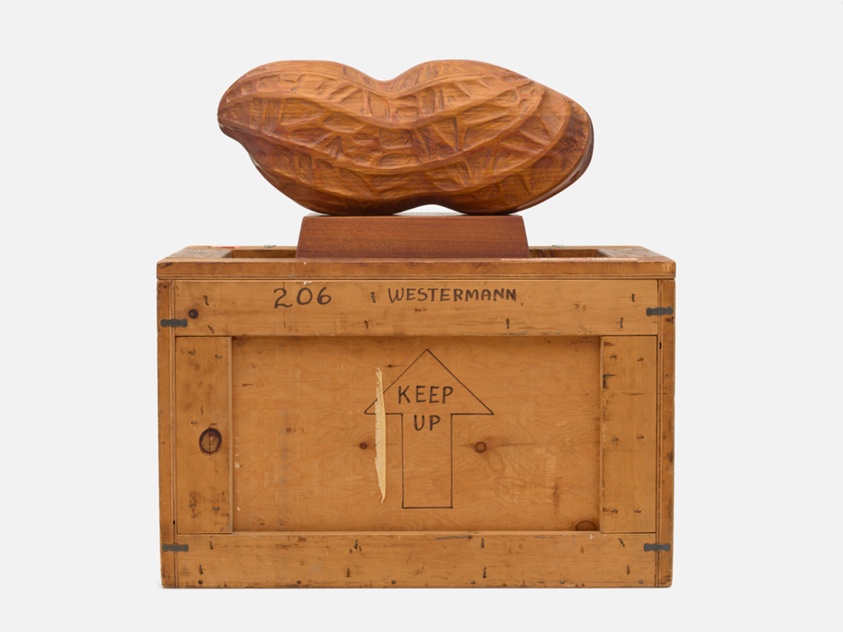
A wooden sculpture shaped like a peanut sits atop a wooden crate labeled “KEEP UP” with an upward arrow, and the text “WESTERMANN” and “206” written on the crate. The background is plain white.

H.C. Westermann, “Untitled (Second Peanut),” 1973, eastern pine, walnut and rubber bumpers, 14″ × 25″ × 9 1/2″/Photo courtesy of the Art Institute of Chicago. Gift of the Estate of Alan and Dorothy Press in acknowledgment of their family

You don’t typically expect wood to be tongue-in-cheek. But that’s the mastery of war veteran and sculptor H.C. Westermann, who managed to create wooden sculptures that seem playful or satirical at times. His genius with wood and other materials is evident in the Art Institute of Chicago’s “H.C. Westermann: Anchor Clanker,” curated by Giampaolo Bianconi, Dittmer Associate Curator at the museum. (The anchor was Westermann’s choice for his signature.)

Tucked in a gallery hugging the Ryerson and Burnham Library on the second floor, the show displays seventeen of Westermann’s sculptures, which the museum reports is the largest display of his works in Chicago in over twenty years, thanks to a 2023 donation from the Estate of Alan and Dorothy Press and their family. It’s an astonishing collection of Westermann’s works, showcasing his genius with wood and other materials.

A sculpture of a human figure with a square green textured body, rectangular arms and legs, a wooden head with an upturned hair detail, and a wooden hand on one arm. The sculpture stands upright on a matching base.

H.C. Westermann, “Hutch the One Armed Astro-Turf Man With a Defense,” 1976, AstroTurf, pine, aspen, ash, chestnut and saplings, 75″ × 28 3/4″ × 21 1/2″/Photo courtesy of the Art Institute of Chicago. Gift of the Estate of Alan and Dorothy Press in acknowledgment of their family

One of his more engaging pieces is “Untitled (Second Peanut)” (1973), which plays around with our expectations about wood and high art. It’s one of two pieces where he carved a peanut shell, a humble and fragile object that he’s putting on a literal pedestal. On top of that, the peanut is carved from the low-cost pine wood, whereas the box underneath the peanut is made from walnut wood, which is more highly prized. It’s a masterful piece, showing Westermann’s command of the wood, while also raising questions about what we should value.

Another humorous and timely piece, “Hutch the One Armed Astro-Turf Man with a Defense” (1976), is Westermann’s objection to the removal of grass from the Astrodome in Houston, Texas for AstroTurf. The sculpture depicts a man, covered in AstroTurf, with a wooden boxing glove head and a wooden hand. It’s missing an arm, referencing the “shoddy workmanship” per the card. The work feels even more timely today as we debate the place and necessity of artificial intelligence in the art world.

A wooden sculpture resembling a tree trunk with a protruding branch is displayed upright in a glass case with a wooden frame and base. The base is engraved with the words FOR HING JEE WING.

H.C. Westermann, “Rotting Jet Wing,” 1966, pine, plate glass, felt and copper, 38 7/8″ × 27 3/8″ × 14 5/8″/Photo courtesy of the Art Institute of Chicago. Gift of the Estate of Alan and Dorothy Press in acknowledgment of their family

While some of his sculptures feel playful, others are much more serious. As a veteran, Westermann has several pieces expounding on the repercussions of war on people and land. For instance, “Rotting Jet Wing” (1966) shows a jet wing encased in a glass box. Unlike the other pieces in the exhibition, this work feels understated and almost mundane; the jet wing seems as if it is wrapped in a shroud. The wall tag explains that it’s Westermann’s commentary about the Vietnam War and its “flagrant disregard for both land and life.” He’s taken away all the bombast and glamour of war and is exposing death and destruction at the center of it.

Once you’ve finished with the main exhibition, head to the Ryerson and Burnham Library downstairs, since there is another of Westermann’s sculptures and some of his ephemera.

Overall, the exhibition demonstrates Westermann’s virtuosity. I can only hope that there may be an even larger show of Westermann’s work in the not-so-distant future.

“H.C. Westermann: Anchor Clanker” is on view at the Art Institute of Chicago, 111 South Michigan, through May 17.

Tagged:
  • Art Institiute of Chicago
  • Giampaolo Bianconi
  • H. C. Westermann

Post navigation

Previous Post Alexa Viscius Photographs the Faces Behind the Music at Epiphany Center for the Arts
Next Post Ann Toebbe Explores Her Mental Map of Hyde Park
A woman in vintage attire with wavy hair sits sideways on a chair, resting her arms on the backrest, and gazes thoughtfully to the left. The photo is black and white with dramatic lighting.

Lee Miller on Both Sides of the Camera A model, war correspondent and innovative artist, Miller's retrospective at the Art Institute celebrates an extraordinary woman.

Susan Aurinko September 23, 2026

Common Destiny: A Review of The Otolith Group at Neubauer Collegium and the Art Institute

Jen Torwudzo-Stroh December 4, 2024

Chicago’s Eccentrics and Masters: A Review of “The Way I See It” at The Drawing Center, New York

Charles Venkatesh Young November 26, 2024

Art 50 2024: Directors and Curators

Newcity September 3, 2024

A magazine cover shows a mans face on the right half, with short hair and a beard. The left half is a wooden texture, roughly matching the shape of his face. The top right reads NEWCITY OCTOBER 2021 in yellow text.

October Issue
Realism

GET A COPY

SUBSCRIBE

White background with the word NEWCITY in large, bold, white uppercase letters. The letters are outlined faintly, blending slightly with the background.
Facebook Twitter Instagram
  • About
  • Privacy Policy
  • Advertise
  • Subscribe
  • Newsletters
  • Chicago Film Project

Copyright Newcity Communications, Inc. © 2026