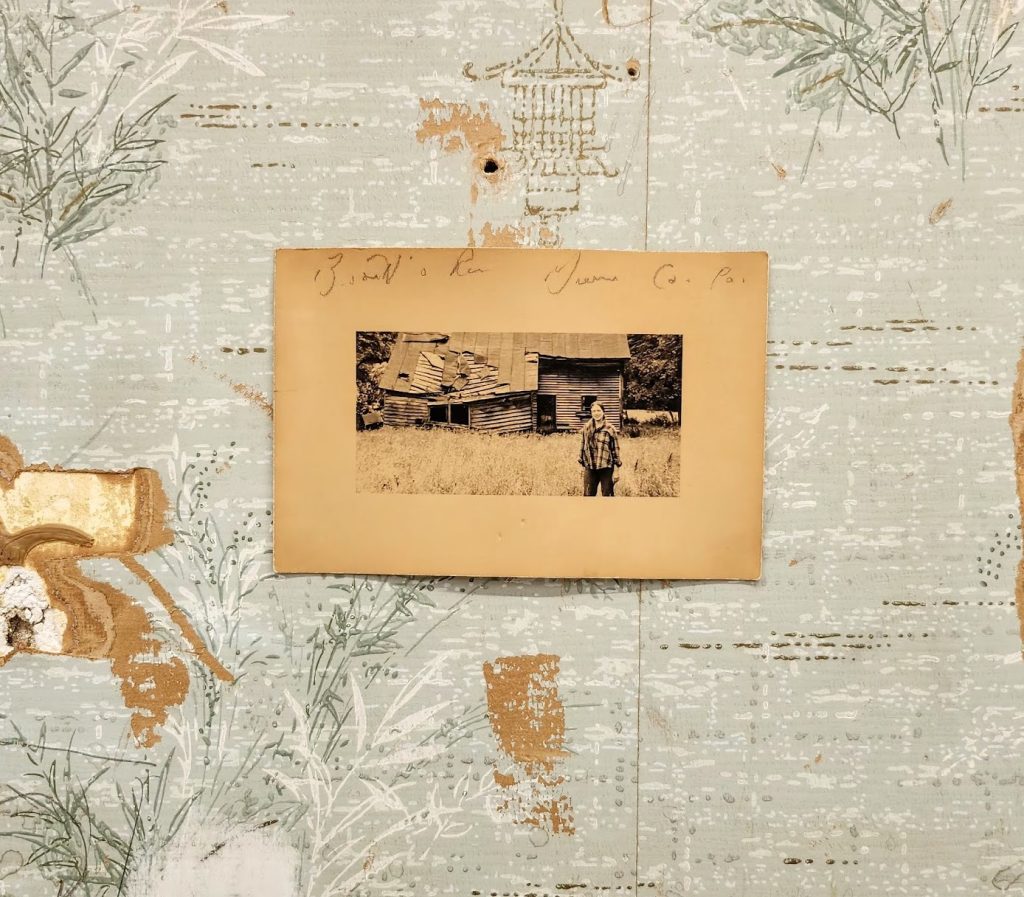
Overtaken by shadow, distorted audio clips, archival images and musky incense wafting throughout—Shabez Jamal’s latest exhibition engulfs the senses. Cloaked in the dark, the exhibition titled “The light shines in the darkness, and the darkness has not overcome it” begins with Room 1 where Jamal’s “Light Study No. 4. (Reflection)/Installation”—made up of a treated pine pillar, laser cut mirrored acrylic, and a red, LED reflection—is centered on the gallery floor. The slivers of daylight squinting through slatted blinds invoke a somber and sinister beginning. The pillar is placed in such a way that it creates a shadow like a building swathed in red light.
Kinloch, Missouri, a historic Black city bought by St. Louis in the 1980s to make way for an airport that never materialized, once held 10,000 residents but is down to a population of 263 according to the 2020 census. In their exhibition, Jamal, born in St. Louis, explores their connection to the hauntingly abandoned Kinloch. “Light Study No. 4. (Reflection)/Installation” plays on themes like “pillars of society,” emblematic of the structures First Missionary Baptist Church of Kinloch and the Kinloch Cotton Club—two stalwarts in the once-thriving Black community. The exhibition’s title refers to the biblical verse John 1:5.
In Room 3, “Light Study No 2. (Moving, moving, all the time, moving),” a lone church pew faces a wall, two windows with curtains drawn, and an arched, red-glowing door. The windows and door filter in intentionally striped light. On the verge of sacrosanct and ritual, the installation holds tension between Black spirituality and Black violence through transcendence and sensory inundation. Along with the singular bench, copies of materials like Toni Morrison’s “Paradise,” Evelynn Hammonds’ 1994 essay, “Black (W)holes and the Geometry of Black Female Sexuality,” and Katherine McKittrick’s “Demonic Grounds: Black Women and the Cartographies of Struggle” are available as suggested materials to delve further into the exhibition’s meditations on Black diaspora and subtext of Black femininity within social and physical landscapes. There’s an overall sense of reflection, remembrance and intensity.

“Light Study No 1. (Order my steps)” in Room 4 reveals Jamal’s bread and butter. Embedded into slabs, archival images of family members are checkered and sealed, grounded in red light. The treated pine and archival images are transferred onto translucent acrylic tiles and white light. Like Kinloch, the sculpture is a ballast to Black cultural history that’s currently threatened with erasure.
Steeped in symbolism, “There’s a Disco Ball Between Us: A Theory of Black Gay Life,” a book by Jafari S. Allen, ties into Jamal’s video self-portrait in Room 4, “A Ritual for Kinloch (Scene from The Offering).” A loop of experimental movements, rituals, altars and Black queerness is projected onto the dilapidated walls of the gallery. Throughout the exhibition, Jamal has culled the very essence of the historic building that is Shed Projects. Jamal’s work considers the immolation of Black spaces, culture and existence with “omnipresent histories of racial violence and dispossession-histories that persist alongside and in tension with Black practices.”
The building’s interior is preserved in its decay. Like the epicarp of a piece of fruit, the door frames are stripped, the paint and wallpaper peeled. Arresting in its intensity, Jamal’s exhibition is a conversation between material and space, of violence and vitality, ritual and rite.
Shabez Jamal’s exhibition “The light shines in the darkness, and the darkness has not overcome it” is on view through September 13 at Shed Projects, 3731 Pearl Road, Cleveland, Ohio.