
In the somewhat perplexing exhibition currently at the Museum of Contemporary Photography, guest curators Joan Giroux and Alice Maude-Roxby—from the United States and the U.K. respectively—consider artists who communicate through their bodies. The show, which features the work of eleven international artists, seeks to create bonds between artist and viewer. Whether through still images or video from performance, the artist/actors reach out to the audience and attempt connection. Many of the artists in this exhibition are deceased, thus many of their works appear as a result of the curators working with museum collections or the artists’ estates. The fact that they are no longer corporeal makes the exhibition strangely intriguing.
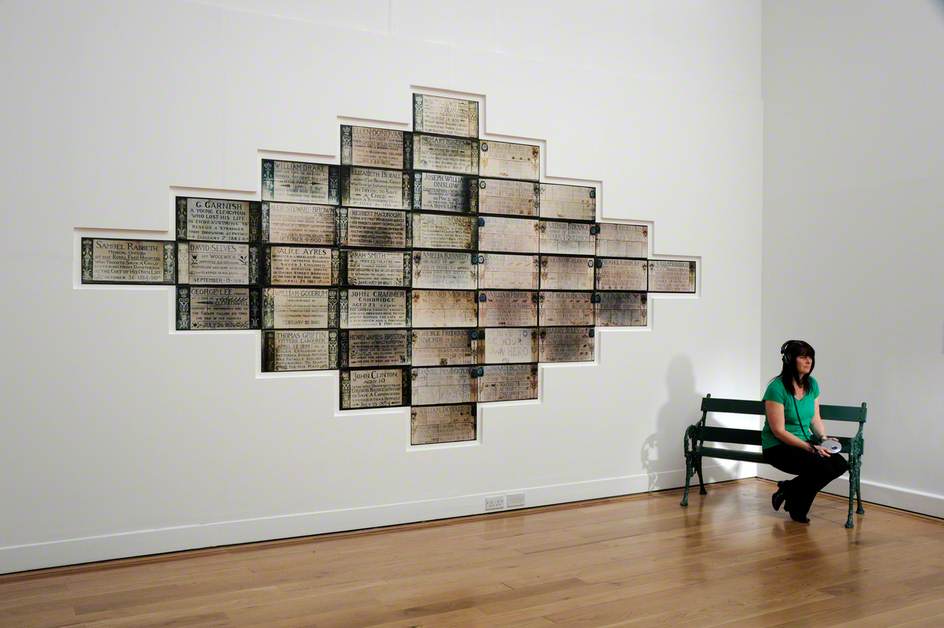
The most visually striking piece, by British American artist Susan Hiller, fills the large wall ahead upon entry to the museum. Hiller, who passed away in 2019, photographed parts of a memorial wall erected in the late 1800s in Postman’s Park, London. The installation, titled “Monument (Colonial Version),” is comprised of tiles that list individuals who died while saving others’ lives. They were ordinary people from the age of nine through adulthood, and the way they died and who they saved is also listed on each tile, along with their names. On one of them is the handwritten phrase “Strive to be your own hero.” Hiller also has placed a park bench at a slight angle before the wall piece on which there is a recorder with headphones in which she speaks to the viewer/listener, from the grave, so to speak. In the project space, German artist Gustav Metzger, also deceased, created an installation of an enormous yellow sheet. Titled “Historic Photographs: To Crawl Into—Anschluss, Vienna, March 1938,” the piece invites the viewer to participate by climbing under the sheet.

Shari Rothfarb Mekonen, still from “Ocean Avenue,” 1999, 16mm film, with sound/Photo: MoCP and the artist
Another powerful piece is a video installation on the second level of the museum, “Ocean Avenue,” in which an Orthodox Jewish woman going through menopause visits the Mikva for the last time. Made in Brooklyn, it gives a glimpse of the borough and its inhabitants as the woman, whose name is Luna, walks through the streets with a video camera, looking for her daughter—which we learn toward the end of the video is the daughter she never had. Luna herself is a poignant character and the American artist/filmmaker, Shari Rothfarb Mekonen, created a story that is relatable and endearing.

Pia Arke, “The Three Graces,” 1993. Courtesy of the Pia Arke Estate/Photo: Pia Arke
Pia Arke, who was Kalaaleq Danish, creates a large-scale quadriptych in which three women pose in each of the panels as a modern day “Three Graces.” The women hold items from Indigenous culture that symbolize the silent colonialism of the Danish/Greenland relationship. One of Arke’s video pieces is also in the show, in which she crawls and rolls nude and vulnerable on a pinhole image of the area’s landscape, ultimately tearing it to shreds. Arke says in the didactic, “I am a mongrel. It is probably no coincidence that I turned to photography, which in many ways is the bastard of art forms.” The effects of colonialism run deep, and artist Laura Aguilar also felt the conflict of being both Mexican and American, but actually neither. In her triptych image, an American flag and a Mexican flag flank an image of Aguilar, her nude body draped in both flags and bound with heavy ropes. The meaning, in this piece, as well as all those in the show, is abundantly clear—the body is at the root of all, and here it is used to great effect.
“Channeling: Body <– Image –> Viewer” is on view at Museum of Contemporary Photography, 600 South Michigan, through December 20.

