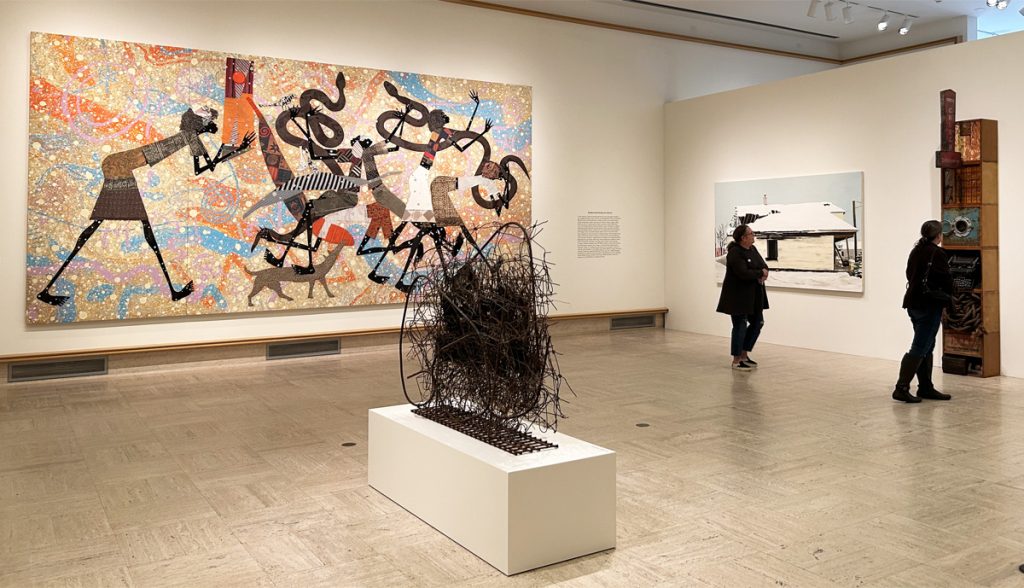
Installation view of “How We Make the Planet Move,” 2024, Cranbrook Art Museum. Left to right: Charles McGee, “Play Patterns II,” 2011, fabric, paper, the artist’s hair, paint, enamel on dibond; Nancy Mitchnick, “13757 Buffalo Street,” 2009, oil on canvas; Clinton Snider and Scott Hocking, “Relics,” 2001-2022, mixed media; (Foreground) Michael Luchs, “Untitled #7 (Wire Rabbit),” 1979, wood, metal, cardboard and paint/Photo: K.A. Letts
“The discipline of art history may be thought of as a continuous reshaping of the past, an ongoing attempt to keep it relevant and infuse it with meaning and purpose,” says art historian James Elkins in his 2002 book “Stories of Art.” An urgent project for twenty-first-century art historians and curators now is to revise the story of contemporary art to include work by previously neglected artists from racial minorities and of different gender identities. “How We Make the Planet Move: The Detroit Collection Part I” marks Cranbrook Art Museum’s commitment to collecting and showing work by Detroit artists that account for this insight.
The exhibition, on view through March 2, 2025, is the first public iteration of Cranbrook Art Museum’s ongoing project to collect and preserve the complex visual culture of Detroit and introduces a long-range undertaking. Kat Goffnett, who organized the exhibition along with Laura Mott and Andrew Blauvelt, explains, “This is the first public debut of this collection, which will grow over time. We plan to create other exhibitions from this collection, which contains hundreds of works, in the coming years.”
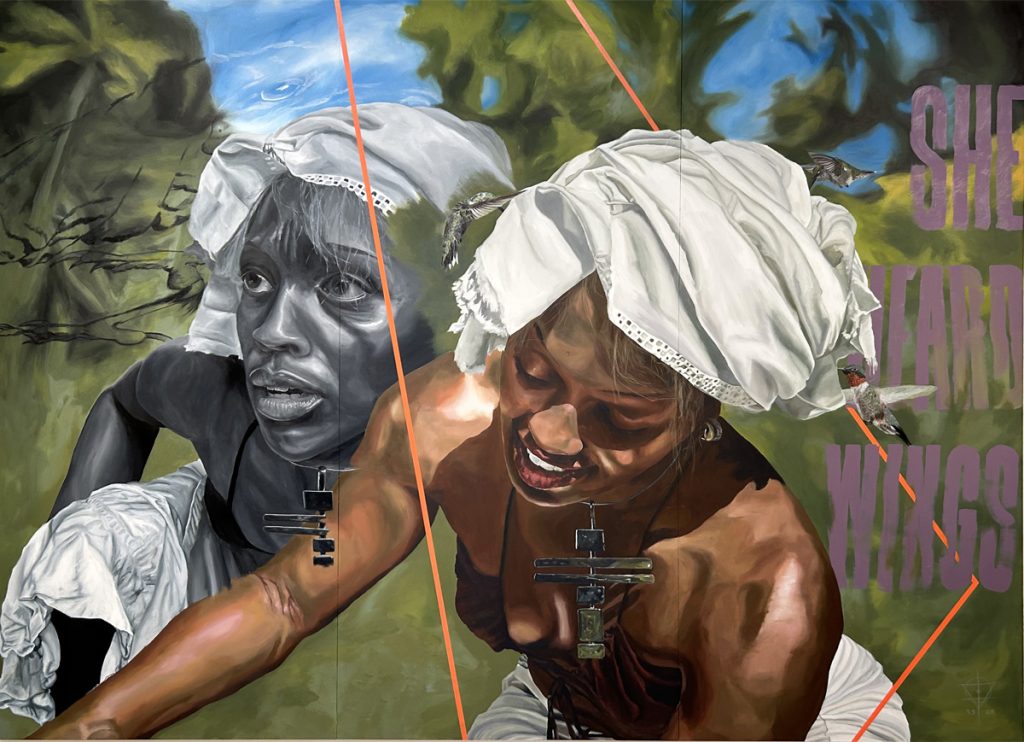
Bakpak Durden, “She Heard Wings,” 2024, latex paint, enamel, spray paint/Photo: K.A. Letts
Established in 2016, the Detroit Collection is made up of over 300 works whose acquisition was made possible through substantial donations of art and funds from private and public sources. It is the museum’s first permanent collection entirely focused on Detroit artists. The exhibition of some thirty artists includes a number of relative newcomers, while others have lived, worked and contributed to the city’s idiosyncratic local culture for decades. All are more than ready for their introduction to a national audience outside of the Great Lakes region.
A wall-size painting by Bakpak Durden, a young, self-taught Black artist, greets museum visitors at the exhibition’s entrance. “She Heard Wings” was inspired by Toni Morrison’s novel “Beloved” and seamlessly creates a satisfying visual pastiche from sources that include dramatic cinema and Dutch Baroque painting.
If there is one art-historical omission that is being corrected with the new collection, it is the overdue recognition of African American artists who have contributed immensely to the city’s art ecosystem. A mural by Charles McGee, “Play Patterns II” (2011), dominates the large central gallery and can be viewed as a coda to the equally monumental “Noah’s Ark: Genesis” (1984), now part of the Detroit Institute of Art’s collection. McGee’s lifetime of work was recently honored in a comprehensive retrospective, “Time is Now,” at the Shepherd in the summer of 2024, and his murals and sculptures can be seen throughout the city. In addition to his public artworks, McGee, who died in 2021, is remembered for his mentorship of young African American artists and his curatorial support for his creative contemporaries.
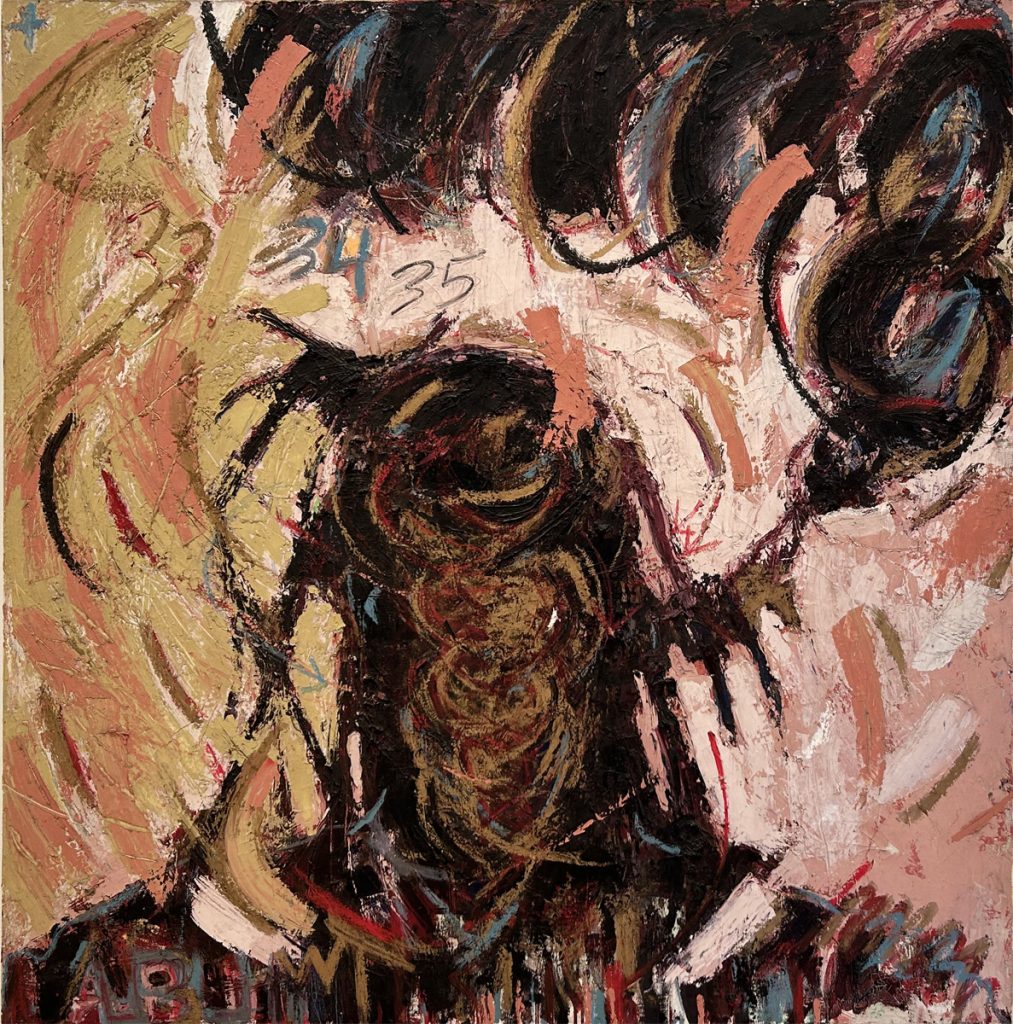
Gilda Snowden, “Album,” 1989, oil on canvas/Photo: K.A. Letts
It was heartening to see Gilda Snowden’s painting “Album” (1989) installed among her peers. Like McGee, Snowden was known as an educator and mentor to young artists. Her sudden and premature death in 2014 exposed her to a common hazard for women artists—that of being written out of art history. The medium-size painting on display is typical of many of her self-portraits, combining a turbulent painterly atmosphere with a palpable sense of her presence.
Nancy Mitchnick’s elegant painting of a derelict single-family dwelling, “13757 Buffalo Street,” turns ruin porn on its head. She has transformed one of Detroit’s many still-standing eyesores into an artwork that would be at home in an Architectural Digest lifestyle spread. Next to her painting, the tower of discarded artifacts that makes up “Relics” (2001-2022), by Scott Hocking and Clinton Snider, illustrates, once again, the alchemical proclivities of Detroit’s artists, employing old typewriters, rope and discarded signage to create keys for a lost city.
The curators’ stated project of showcasing previously marginalized artists yields, paradoxically, an abundance of artworks that are very much in the mainstream of contemporary practice. An accomplished fiber artist like Carole Harris fits well within today’s cannon, her work distinguished by its superior formal qualities. She both represents and transcends her personal history as all great artists must. Lester Johnson and Allie McGhee exhibit similar mastery, which isn’t to say that these creatives deny their racial identity, merely that it is only one of the features that render their work significant.
In the twenty-first century, many young Black artists in the city have adapted figurative painting to convey their personal and political narratives. Mario Moore’s “Thornton and Lucie Blackburn in Canaan,” impressive in scale and technique, fills a wall with a larger-than-life African American couple, the man looking out from the picture as they recline on the Canadian shore. In the background, present-day Detroit has burst into flames.
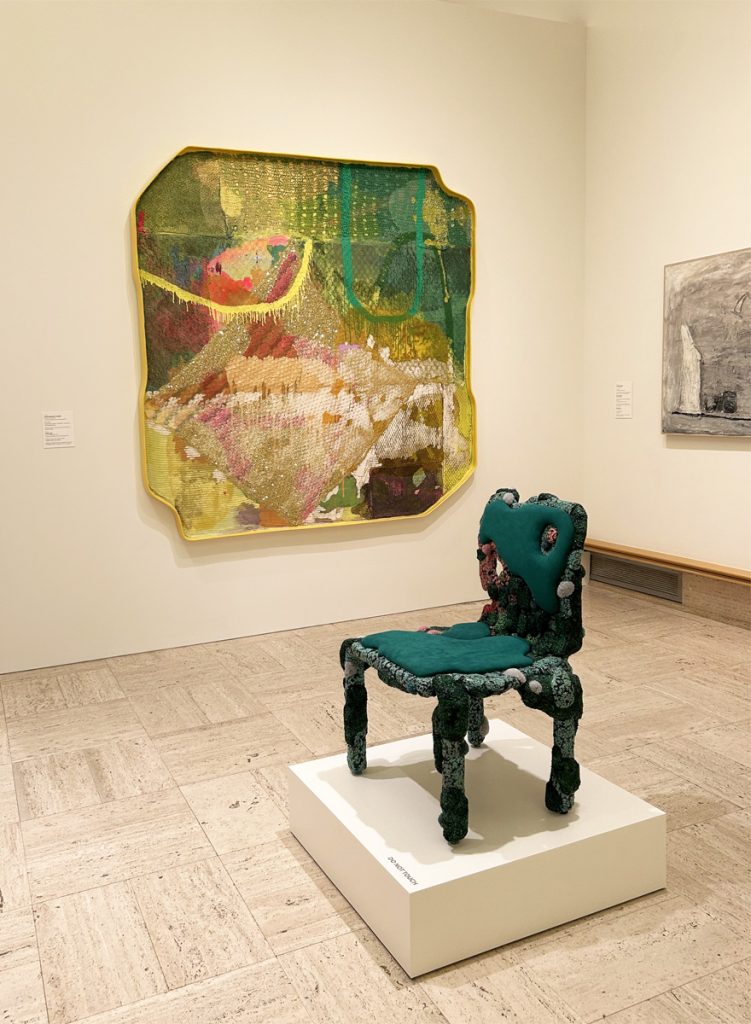
Installation view of “How We Make the Planet Move,” 2024, Cranbrook Art Museum. Background: James Benjamin Franklin, “Rise,” 2022, acrylic, fabric, plaster, sand, glitter, epoxy on extruded polystyrene; foreground: Jack Craig, “Molded Carpet Chair,” 2024, molded carpet, wood, fabric/Photo: K.A. Letts
Detroit artists continue to explore exuberant abstraction and the adaptation of industrial materials in futuristic incarnations. James Benjamin Franklin’s brash, acid yellow collage painting “Rise” illustrates a typical urban practice of combining decorative and industrial materials. Nearby, Jack Craig transforms what might be industrial sludge into an improbably elegant form with his “Molded Carpet Chair.”
Hubris is an occupational hazard in curating contemporary art. Just as museums have celebrated white men over the centuries, excluding women and minorities—and even whole civilizations—what distortions and omissions today’s curators will be found guilty of by future generations can’t be known. The organizers of this exhibition are appropriately humble when they say, “No single exhibition can tell the story about Detroit or its artists. Instead, the past and future evolution of Detroit’s artistic scene contains multitudes.”
“How We Make the Planet Move” represents a good-faith effort to describe Detroit’s art history in light of what we now know, while leaving room for adaptation and addition as that story continues.
“How We Make the Planet Move: The Detroit Collection Part I” is on view at Cranbrook Art Museum, 39221 Woodward Avenue, Bloomfield Hills, Michigan, through March 2, 2025.