“Before the Freeway,’ 2008, machine pieced and machine-quilted patterned and solid cottons. Loan courtesy of Deborah Kin and Dennis Teichman/Photo: K.A. Letts
As an unabashed admirer of Detroit fiber artist Carole Harris, I have been awaiting her solo show at the Museum of Contemporary Art Detroit (MOCAD) with great anticipation. I hoped for a full retrospective—certainly with sixty years of life and work under her belt Harris deserves it—but “This Side of The River” turns out to be more modest in scope and more deeply entwined in Detroit’s art history than I had expected.
MOCAD curator Abel Gonzalez Fernandez has chosen a relatively small collection of artworks from Harris’ voluminous output to reflect the city’s tumultuous history through the lens of her creative career. The twenty fiber pieces and archival materials included in the exhibition track and comment on civic events and Harris’ response to them in her work from 1966 to the present. The survey provides Harris with a compelling origin story and fills in some neglected historical gaps, but necessarily leaves out much of what I consider to be her most significant later work.
Ample space is devoted to the display quilts and wall hangings that Harris produced from the 1970s to the 1990s. During that time, Detroit passed from dynamic manufacturing hub to deindustrialized relic, though the streets and neighborhoods of the city retained a distinct culture and a resilient spirit. It was a period of turmoil, and Harris responded to events by producing work that reflected the times.
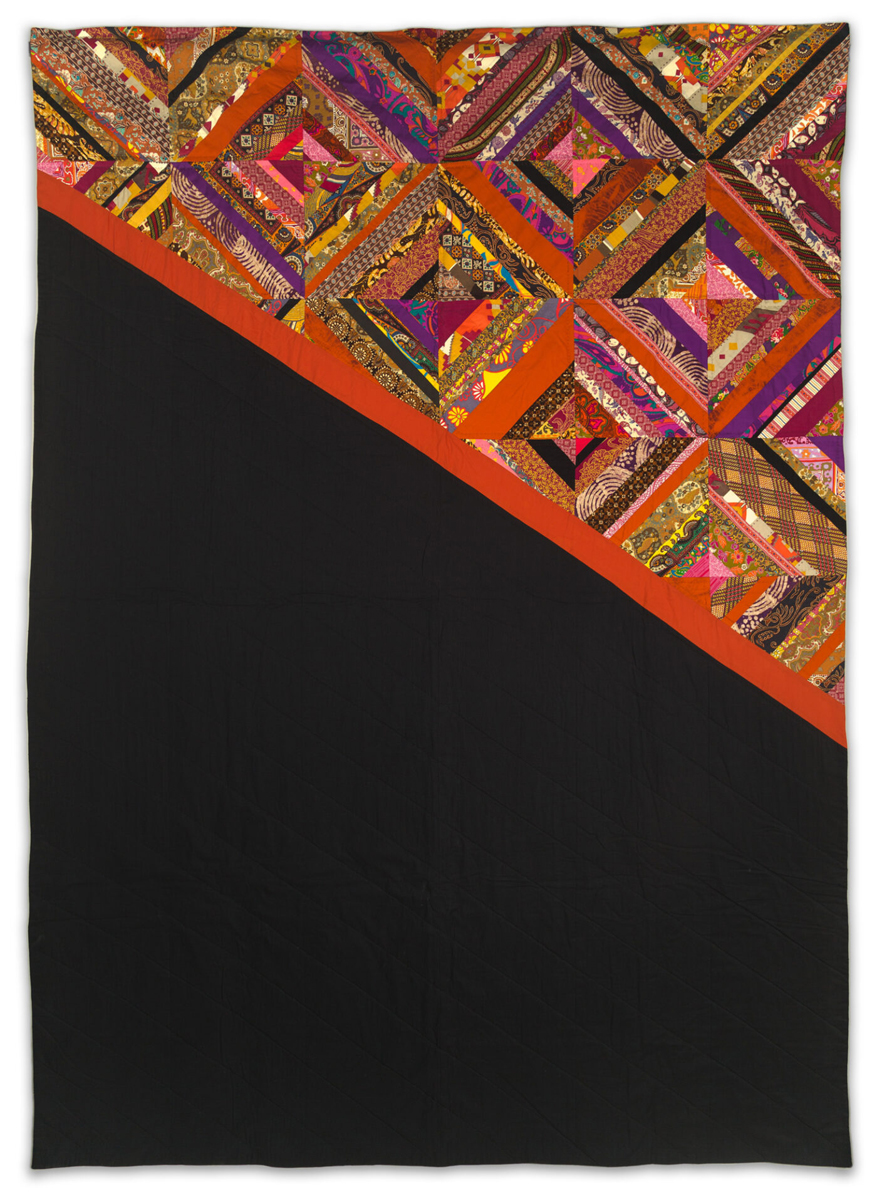
“Potpourri,” 1976, commercially printed cotton with cotton batting, machine pieced and hand quilted. Photo courtesy of the artist.
Harris debuted her inaugural solo exhibition in 1977. The venue was Gallery 7, a collaborative art space founded by legendary Black artist Charles McGee. It was a hotbed of Black Power activism and discourse (and it was also a bit of a boys’ club—it appears Harris was the only female artist to show her work there during the ten years of the gallery’s operation.) “Potpourri” (1976) and “Black Jack” (1976), both from that exhibition, are included in “This Side of the River” and, along with her 1969 “Wedding Quilt,” show the relatively conventional baseline from which Harris’ later, more formally adventurous textile pieces grew.

“Do You Feel Like Dancing,” 1995, machine pieced and hand-quilted, commercially printed cottons, gold lame, cotton cord and thread, cotton batting, wrapped cord. /Photo: K.A. Letts
In the mid-1990s and into the early 2000s, flashes of originality appeared in Harris’ work and foreshadowed later breakthroughs. Pieced textiles such as “Do you Feel Like Dancing” (1995) and ‘Whispers” (1994) combined aspects of fine craft quilting and African textile art that the artist viewed as reflective of the urban landscape. She continued to develop her signature style, which featured brilliantly colored, commercially dyed fabrics, a fondness for diagonal composition and machine quilting backed in black fabric.
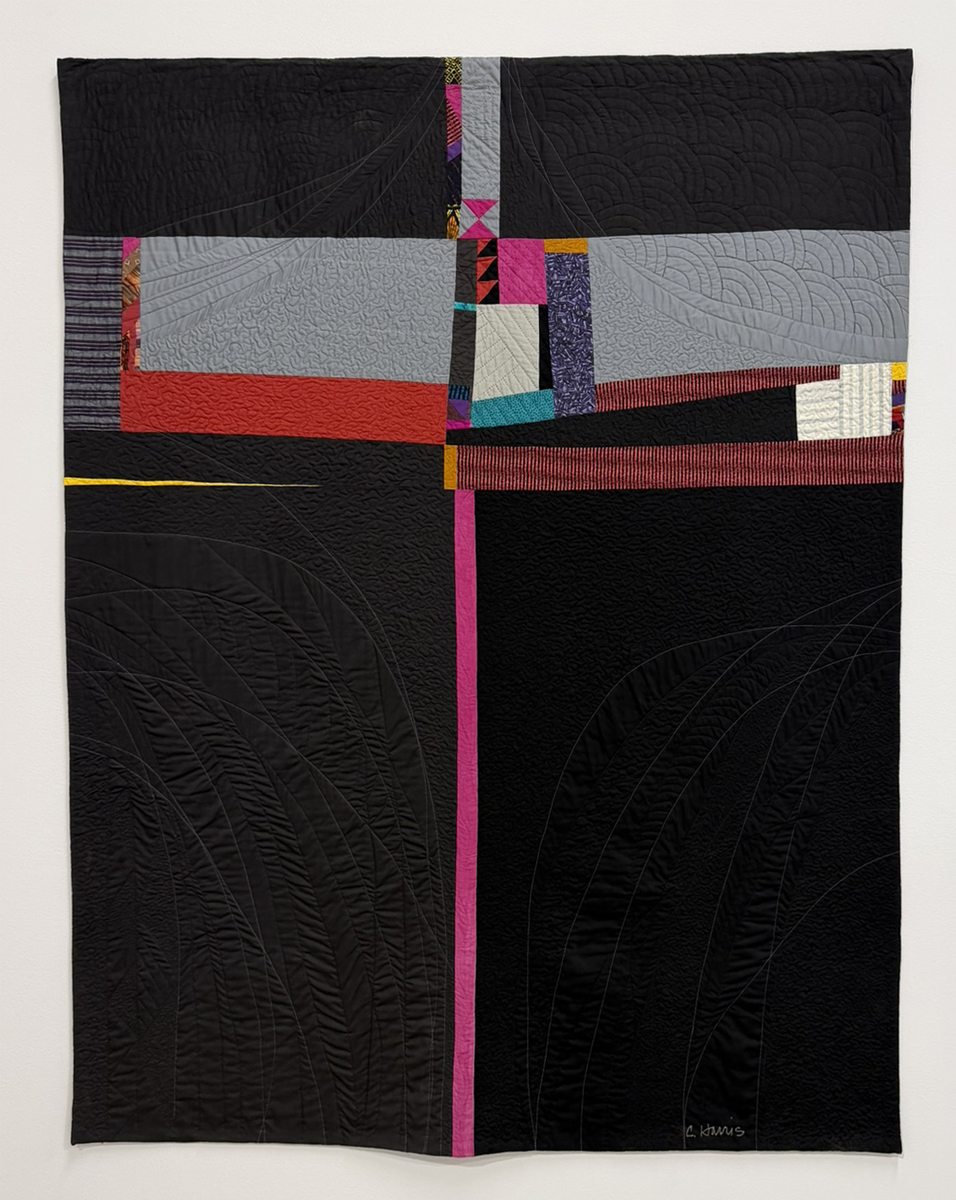
“Down the Road a Piece,” 2003, machine pieced and machine quilted, commercially dyed printed and solid cottons. Loan courtesy of Michigan Council for the Arts. /Photo: K.A. Letts
Harris’ 2003 quilted tapestry “Down the Road a Piece,” on exhibit here, provides startling evidence that she was beginning to think about her work in a new way. More reminiscent of a Richard Diebenkorn painting than of a traditional quilt, the textile features a thick band of commercially dyed but relatively subdued blocks in gray, charcoal and purple. The somber colors are punctuated here and there with smaller strips and triangles in red, yellow and hot pink. Black quilted fabric dominates the remainder of the composition.
By the first decade of the twenty-first century, Harris had become increasingly personal and improvisational in her creative approach. The artworks from this period follow a constructivist strategy of allowing the interior shapes of the compositions to dictate their outer configuration. Although abstract in form and still quite decorative, her pieced textiles continued to reference events in Detroit’s African-American community.
Harris’s 2003 discovery of Boro, a traditional Japanese fabric-mending craft that acknowledges and celebrates the expressive potential of imperfect and worn fibers, had a marked influence on her evolving style. Her work underwent an even more profound transformation in 2008 when she retired from her full-time career as an interior designer. Freed of time constraints, Harris was able to devote herself completely to her fine-art practice. At about that same time, she became aware that “ruin porn” tourists were beginning to visit Detroit. She recounts her injured reaction in a 2024 interview for Bomb magazine:
“People had been visiting Detroit to see and photograph many of our older buildings. They wrote about those buildings calling them ruin porn, which I found very offensive—calling our buildings ruin porn because they were in a state of deterioration. A lot of the city was. For me, it was very unsettling that people looked at my city in this way, the city that I loved.”

“In a Silent Way,” 2017, machine quilted and hand embroidered, hand dyed and appliqué on printed cotton, acrylic paint on muslin, cotton batting. Loan courtesy of Cranbrook Museum of Art. Photo courtesy of the artist.
In response, Harris began, with increasing intentionality, to incorporate the colors and surfaces of Detroit into her art practice. Artworks like “Remnant” (2013), “In a Silent Way” (2017) and “Free to Be” (2021) mirror urban textures and tones that she considered beautiful and reflective of the lives and stories of Detroiters. She began to dye and distress fabrics and to use natural materials she found in the streets, such as rust, to color parts of the fiber works, and occasionally painted irregular patches of color on the fabrics in acrylics. Vintage and damaged textiles with raw edges and hanging threads, hand quilting, appliqué and embroidery appeared as part of her compositional vocabulary and added emotive power.
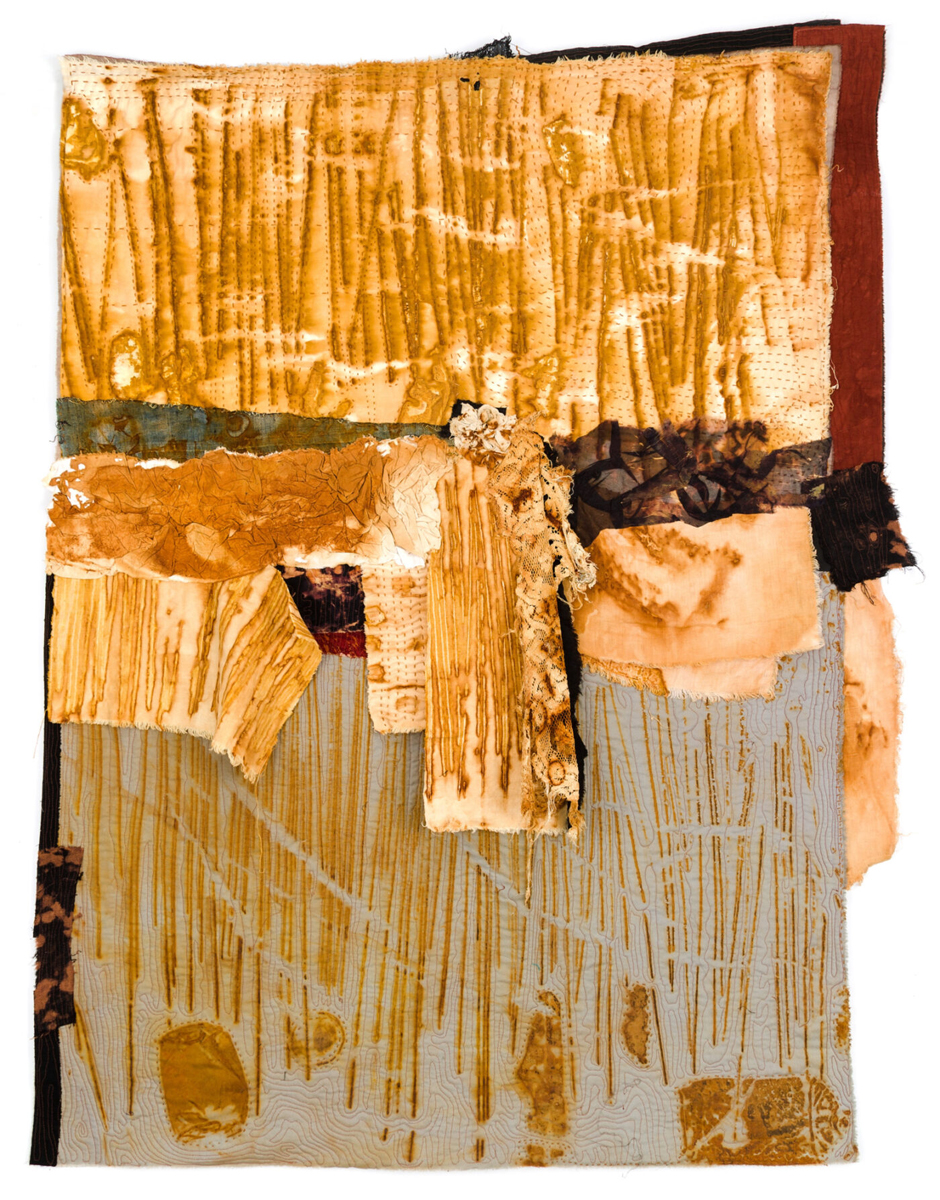
“Free to Be,” 2021, machine and hand quilted rust-dyed miscellaneous fabrics, photo courtesy of the artist.
Her large 2021 fiber piece “Free to Be,” in particular, signals Harris’ declaration of independence from considerations of craft or decoration. With this textile, Harris shows herself to be unconstrained in her creative vision, wielding her needle, scissors and fabric with the same abandon as a painter might splash a canvas with brush and paint. In my opinion, her work since then has only become more personal, more expressive and… just more.
“This Side of the River” writes a first chapter in the ongoing story of Carole Harris’ lifelong creative journey, documenting her evolution from traditional quilt maker to Detroit’s premier fiber artist. A single, small artwork included in the exhibition, “Beyond the Surface,” hints at Harris’ current direction, inspired by her exploration of the traditional Korean felting process called Joomchi. While I would like to have seen more work in the exhibition that reflects the artist’s fiber art as it is now, it must be acknowledged that the earlier works on view provide valuable insights and historical context. Perhaps they will set the stage for the comprehensive Carole Harris retrospective I hope to see one day.
“Carole Harris: This Side of the River” is one of three solo shows that opened the newly refurbished, and much improved, Museum of Contemporary Art Detroit (MOCAD) on view until June 21. In addition to “This Side of the River,” a comprehensive retrospective of work by Olayami Dabls, “Detroit Cosmologies,” on view until July 12. Detroit artist Martha Mysko’s immersive installation “Retail Therapy” on view until June 21. Museum of Contemporary Art Detroit (MOCAD), 4454 Woodward Avenue, Detroit, Michigan.