Matias Armendaris and Hanya Beliá, Installation view of “ASMA, Wander and pursuit,” 2024, at Museum of Contemporary Art Detroit/Photo: MOCAD
The race to define Surrealism 2.0 is on. First-wave Surrealism of the early twentieth century, with its emphasis on dreams and the unconscious, was supplanted around 1966 as a credible aesthetic philosophy by the logic of Greenbergian minimalism. But as advances in digital technology blur the line between what we think of as reality and increasingly intrusive and persuasive online versions of, well, something else, our confidence in the rational has been shaken. Some contemporary artists begin to perceive that Surrealism’s explorations of the irrational can be adapted to make sense of a world that has now surpassed both our dreams and our nightmares.
The Museum of Contemporary Art Detroit has waded into this area of growing interest with four new exhibitions that propose a variety of Surrealisms, each featuring its own set of guiding principles. If the exhibitions at MOCAD are to be taken at face value, the tools and art traditions of painting and sculpture, once so central to first-wave Surrealism, have been undermined and superseded by worldviews and visual sensations that owe their existence to video games and science fiction films.

Chris Schanck, “Shuddering Cabinet,” 2022, steel, wood, polystyrene, aluminum foil, resin/Photo: MOCAD
“Chris Schanck: A Surreality”
The Woodward Gallery at MOCAD, the museum’s largest, contains a collection of objects and furnishings by Detroit artist Chris Schanck, entitled “A Surreality.” A 2011 graduate of Cranbrook in design, Schanck has given time-honored art concepts like “truth to materials” and “form follows function” the old heave-ho as he heads for parts unknown. His explorations of popular science fiction and fantasy are fertile sources for his free-form furniture. These outlandish creations, made from sticks, trash and other low-brow materials, are wrapped in aluminum foil and covered with tinted resin, which gives them a kind of creepy, down-market opulence.
Schanck’s artworks demand to be taken on their own terms, products of an imagined civilization whose guiding principles are unknown. A trip around the capacious gallery invites confusion; these objects are identifiable chairs, mirrors and tables, but created according to the rules of an alien aesthetic—what I would call Baroque Surrealism. Schanck’s design principles are irregular, bizarre, self-consciously dramatic and disrespectful of classic criteria and proportions. His governing rule seems to be that there are no rules. He says, “If we accept the idea that [an object] doesn’t have to be reproducible and doesn’t have to mimic a commercial form, or process, then what are the limits of that?” Schanck seems bent on finding out.
As I walk through the installation, I begin to feel as if I am in an off-planet furniture showroom, about to be encouraged by a many-armed salesman to purchase a free-form etagere or multi-chambered cupboard for my astral pod.
I flee the scene.

Levon Kafafian, “Third Chamber,” 2024, pilgrimage site, relic of the Torchbearer installation, at Mike Kelley’s “Mobile Homestead,” MOCAD/Photo: K.A. Letts
“Levon Kafafian: Portal Fire: Shrine of the Torchbearer”
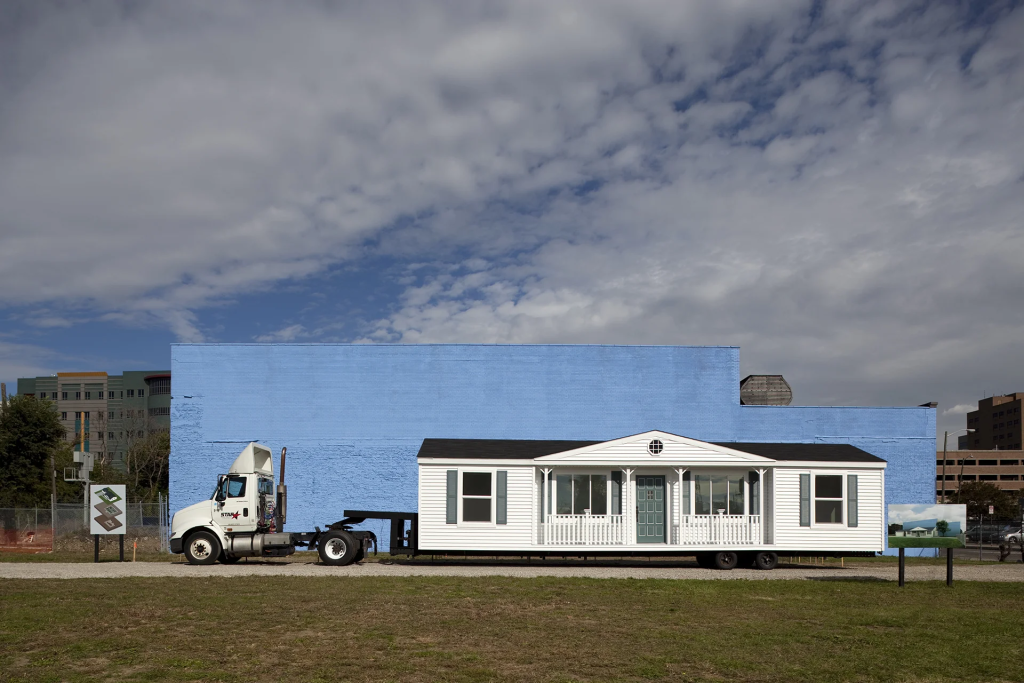
A short walk outside the main building takes me to Mike Kelley’s “Mobile Homestead,” a modest ranch-style annex to MOCAD’s larger structure. What I find there is a multi-part installation by fiber artist and world-builder Levon Kafafian. Their “Portal Fire: Shrine of the Torchbearer” is a physical manifestation of an imagined world created by the artist but grounded in a number of identifiable sources. In three adjoining rooms, we explore Kafafian’s imaginary realm Azadistan, loosely based upon their Armenian heritage, but set a thousand years in the future and described by a rich trove of textiles, costumes, texts and installations. In an accompanying handout, Kafafian has helpfully provided a short fragment of an ambitious graphic novel they have in mind, along with an accompanying interview highlighting “the intersections of Armenian futurism, world-building and material culture.” With all due respect to the artist’s stated influences, “Portal Fire: Shrine of the Torchbearer” suggests an intensely cinematic vision and is strongly reminiscent of fantasy science fiction films such as “The Fifth Element” and “Dune.”

Levon Kafafian, “Second Chamber,” 2024, installation with detail of floating cleric, 2024, at Mike Kelley’s “Mobile Homestead,” MOCAD/Photo: K.A. Letts
“Clare Gatto and Kara Güt: Magic Circle”
Back in the central gallery of MOCAD’s main building, I come upon “Clare Gatto and Kara Güt: Magic Circle.” In their first museum collaboration, this art partnership begins its exploration of the surreal from the starting point of fantasy role-playing video games. They describe their goal in creating “Magic Circle” as an attempt to “collapse the boundaries dividing the virtual from the ‘real’.” (The term “magic circle,” in video game parlance, is the virtual point at which the rules governing the artificial reality of a video game replace the rules of everyday reality.) Gaming culture certainly would seem to offer fertile ground for exploration of the convergence between what we perceive as reality and another digital reality—or possibly “digital surreality.”
In simple descriptive terms, Gatto and Güt have created an installation consisting of a collection of large, artificial volcanic “rocks” in various sizes and shapes, each embedded with a video that evokes flowing streams of water. The objects are displayed throughout the gallery in what appeared, to me at least, to be random order. I wandered through the boulders, imagining myself as a digital avatar moving about scattered elements in cyberspace with no end in sight, and no beginning either. I missed the lack of a narrative arc that would make their stated theme more visceral.
What is provided in abundance, though, are many, many explanatory wall labels. The accompanying catalog gives academic heft to an insight that is intuitively obvious: that our everyday world is not the same thing as the virtual world, the latter being open to constant manipulation and transformation.

Clare Gatto and Kara Güt, “Tower,” 2024, looped video encased in a composite of sand, wood, glue, foam and paint/Photo: K.A. Letts
“ASMA: Wander and Pursuit”
In the entry gallery of the museum, I happen upon what looks to be an ordinary office cubicle with four workstations. But upon closer inspection things get more and more curious. “ASMA: Wander and Pursuit” is yet another installation-based attempt to define new-wave Surrealism in the twenty-first century. Designed and executed by artist duo Matias Armendaris and Hanya Beliá of Mexico City, it succeeds by starting from a point of banality, then slowly, slyly subverting our perceptions with clever interpolations of imagery and ideas, many drawn from art history.
The modest propositions of “Wander and Pursuit” are based upon “metamodernism,” an idea that allows and encourages systems of thought that allow for ambiguity and creative paradox. As humans and machines move toward cyborg convergence in both physical and cyberspace, extreme philosophical and aesthetic hybridity begins to seem normal.
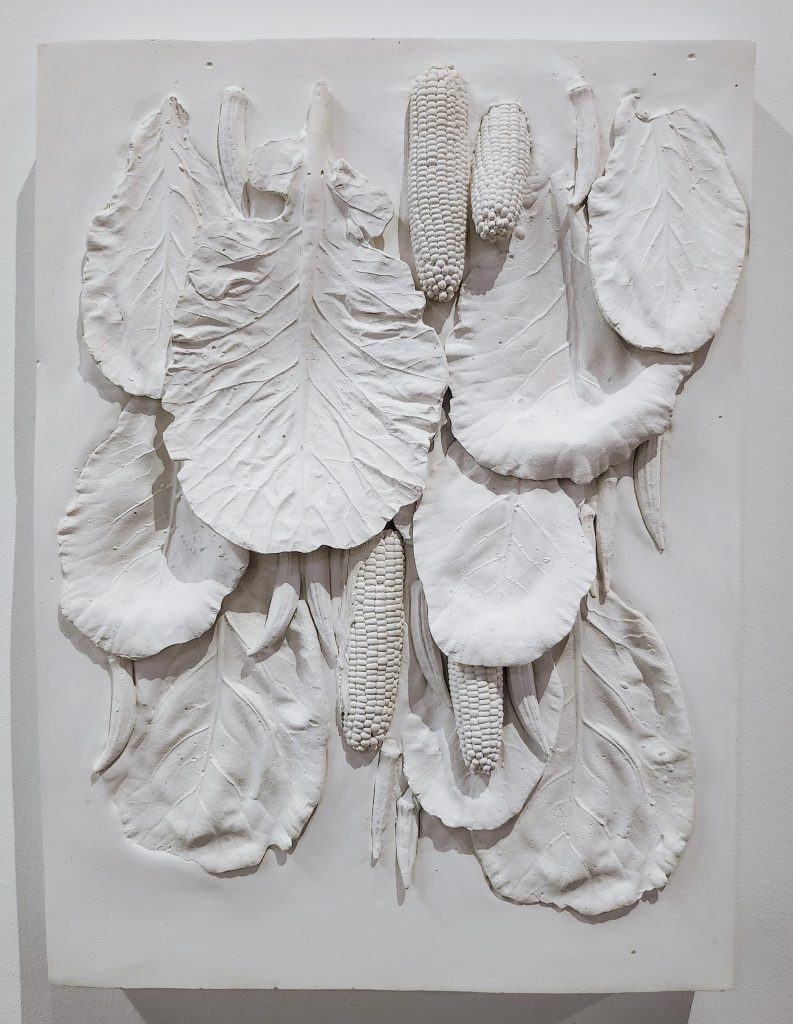
If this seems a little overly cerebral, keep in mind that the artists have leavened their bland environment of computers, printers and HVAC ducts with scenes of walled gardens and romantic chivalry. In this human-machine hybrid world, the wall vents (etched to resemble the surface decoration of medieval armor) stand in for the visors of knights’ helmets, through which we see an occluded landscape. The locked computer printer, amusingly trimmed with faux medieval hardware, spits out, on demand, copies of an unseen original. The screens at the workstations feature shadowy, low-relief scenes of plants and animals and (surprise!) even some imagery that resembles historic Surrealism.

Matias Armendaris and Hanya Beliá, work station detail of “ASMA, Wander and pursuit,” 2024, at Museum of Contemporary Art Detroit/Photo: K.A. Letts
In many ways, new-wave Surrealism, the outlines of which are only dimly visible at this moment, may be uniquely suited to our current unsettled aesthetics, disorienting technological advances and dysfunctional politics. Visual representations that take into account the world of dreams and the unconscious and their interaction with digital technology seem newly relevant. The four exhibitions at MOCAD supply points of departure, of which there may be many more, for future exploration.
As I exit, inevitably, through the gift shop, I am aware of changes in my perception of the world around me. Suddenly everything, conditioned by my museum visit, looks a little strange—doorknobs, wastebaskets, bicycles. I feel a little confused, disoriented. I wonder, is this what Surrealism 2.0 feels like?
“Chris Schanck: A Surreality,” “Levon Kafafian: Portal Fire: Shrine of the Torchbearer,” “Clare Gatto and Kara Güt: Magic Circle” and “ASMA: Wander and Pursuit” are on view at the Museum of Contemporary Art Detroit, 4454 Woodward Avenue, Detroit, Michigan, through February 23, 2025.